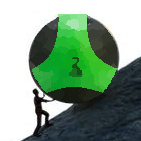

Gambling is flourishing because it meets the needs of our moment: a low-trust world, where lonely young people are seeking high-risk opportunities to launch them into wealth and comfort. In such an environment, financialization might seem to be the last form of civic participation that feels honest to a large portion of the country. Voting is compromised, and polling is manipulated, and news is algorithmically curated. But a bet settles. A game ends. There is comfort in that. In an uncertain and illegible world, it doesn’t get much more certain and legible than this: You won, or you lost.
Bleak as hell to contemplate that the war in Iran is somehow due to something even more callous and nihilistic than fascism
Edit: This is all garbo. See below.
need money to do anything else, money only stops being important when you have enough of it. Then it wraps around and becomes the only thing that matters again when you have too much and you turn into Smaug.
What is the right interpretation of the graphs? Patriotism for a fascist empire is inherently fascist, and naturally some of the others automatically follow when more of the
 of
of  is plunged into living paycheck to paycheck. Even community involvement might be explained that way.
Decline in material conditions probably explains a lot, and if you pull out the crosstabs it seems like what’s happening is the “very” folks are shifting into the “somewhat” column (only 11% rated patriotism as “not important at all”). The wording of the question might also be weird - it asks “How important are each of the values to you personally” and then the money question is literally just “money,” not “having enough money to feed my family” or “having more money than most people”. Anyone worried about not having enough money is probably choosing the former interpretation.
“Hard work” also scores a whopping 94 on the very/somewhat important answers, higher than everything else (self-fulfillment is second at 91, followed by money and tolerance for others, tied at 90; it also comes in at 67 on “very important”, 9 points ahead of the runner up, tolerance for others), so the conclusion that people are pivoting en masse to scams and get rich quick schemes and screwing everyone else over as central values doesn’t seem to hold.
Guess I should’ve applied more skepticism.
Yep, as the cliche popularized by Mark Twain goes:
There are three kinds of lies: lies, damned lies, and statistics.
Thank you for confirming my skepticism of the interpretation by the author you shared. I think the author is definitely to blame for the bad interpretation, and perhaps motivated by the contradiction of also still wanting to defend gambling even despite the headline.
The author is one of the Abundance libs. He’s got Peter Thiel connections.
(Edit:) Embarrassing: Peter Thiel’s Zero to One Might Be the Best Business Book I’ve Read
Peter Thiel connections deserves to downgrade this automatically to !slop@hexbear.net IMHO
Agreed. I figure the only reason Derek Thompson isn’t as loathed as Ezra Klein or Matthew Yglesias around here is that he’s somehow more forgettable.
Yeah I think those are bullshit. Let me pull up my Graphs that show all the young people are actually evil
to the limited extent i had any community before, one group folded due to covid and the other decided to pretend covid ceased to exist. Followed immediately by 100% of the group who went to a convention coming home sick with it.
Very true,
 definitely has changed group dynamics in a way that’s quite difficult to reverse, even if people want to pretend nothing happened.
Cool how this article is still pro-gambling but only when its Regulated
Yeah, I tripped over this take:
But I think dystopias more likely happen because seemingly good ideas go too far. “Pleasure is better than pain” is a sensible notion, and a society devoted to its implications created Brave New World. “Order is better than disorder” sounds alright to me, but a society devoted to the most grotesque vision of that principle takes us to 1984. Sports gambling is fun, and prediction markets can forecast future events. But extended without guardrails or limitations, those principles lead to a world where ubiquitous gambling leads to cheating, cheating leads to distrust, and distrust leads ultimately to cynicism or outright disengagement.
Recently I saw some youtube video where these gamblers were watching traffic cameras. They bet on the number of cars that would pass through an intersection before the light turned. Grown men screaming at their computers because an arbitrary intersection in an arbitrary city had an arbitrary number of cars go through it that minute.
What the fuck is that doing to brain chemistry? At what point is it considered a terminal illness?
SO hyped for the American cultural revolution
The first thing I will do is gather a bunch of patriotic teenagers and sing songs as we decapitate anyone who owns a gambling website. Songs of JOY.
Behavioral addictions generally aren’t related even in a tenuous conceptual manner to terminal illness because behaviors can be unlearned and in many cases forcibly stopped (e.g. can’t play with fire if you don’t have access to fire).
I get that, but I’ve also known terminal alcoholics. The psychological dynamics of that intensify as the physical ones do. I had patients dying of liver cirrhosis scream at me because I refused to sneak them whiskey, saying I’m failing to do the basic job of a nurse. It’s that specific kind of dynamic I’m trying to capture in comparing the two.
Why are you saying this as though alcoholism is merely a behavioral addiction when you know better than I do that it isn’t? And how do you propose a gambling addict gets gamba cirrhosis?
Will do? We already live in a world where a guy wants to become president just so he gets to manipulate the stock market every way he can to line his pockets.
We already live in a post-gambling world. This is an economic war of all against all.
rvturn to Joey Two Eyes the mob bookie