To expand on the “doesn’t work like that” part:
In the vacuum of space there is no air to exchange warmth with your body, or your space suit. You might be comfy on the side of your body facing the sun (if you’re at that distance where it provides the right amount of radiative heat) but the side facing away from the sun will get no heat, and therefore be cold. I imagine that would feel very weird… if you could feel it on your skin, without a space suit, without being ripped apart by the vacuum, of course.
Does anyone know whether this “uneven distribution of heat energy” is a problem for space suits or if that little bit of air inside is enough to distribute it?
There are glacier fed lakes when i live. You can float in incredibly cold water and if you have just the right equilibrium you can half float in freezing cold water while half getting a nice sun bath. And it IS very weird.
One spot I camped at for many years had nice sandy area that was about 200 meters out into the lake before a drop off. As it was only about a meter deep it used to warm up the top foot or so of the water when it was fairly still and you could stick your arm down into the water and actually feel the temperature drop like there was a line underneath the water.
Was great place to camp before it got overwhelmed by mosquitos
A lot of nice places in the world that are a joy to be in until the mosquitoes show up. Do we have to have mosquitoes? Can’t the world manage without them?
This uneven heat distribution confuses the brain and is perceived as pain. Veritasium (or maybe vsauce) did a video on it. Putting frozen and warm hotdog against the skin.
NASA EVA suits have liquid (water) cooling systems to avoid cooking the astronaut while outside the ISS.
I don’t know how they actually work though. The only way to shed the heat is to radiate it away or to sink it into warming something else up.
Found this on Wikipedia:
In an independent space suit, the heat is ultimately transferred to a thin sheet of ice (formed by a separate feed water source). Due to the extremely low pressure in space, the heated ice sublimates directly to water vapor, which is then vented away from the suit.
The ice sublimator consists of sintered nickel plates with microscopic pores which are sized to permit the water to freeze in the plate without damaging it. When heat needs to be removed, the ice in the pores melts and the water passes through them to form a thin sheet which sublimates. When there is no need for heat to be removed, this water refreezes, sealing the plate. The rate of sublimation of the ice is directly proportional to the amount of heat needing to be removed, so the system is self-regulating and needs no moving parts. During EVA on the Moon, this system had an outlet gas temperature of 44 °F (7 °C),[1] As an example, during the Apollo 12 commander’s first EVA (of 3 hrs, 44 minutes), 4.75 lb (2.15 kg) of feedwater were sublimated, and this dissipated 894.4 BTU/h (262.1 W).[2] The pores eventually get clogged through contamination and the plates need to be replaced.[3]
Though I think that’s specifically for removing the astronaut’s body heat.
What a great system. I wonder how the development of that worked. Did they theorize the necessity of a system like that or were the first space walkers quite unconfortable?
Ever seen a picture of a blobfish in it’s deep ocean habitat vs when it is at the surface? It’s body is adapted to the extreme pressure of the deep sea, and when that pressure is no longer there, the forces keeping it’s shape are no longer present and thus every bit of it expands. That’s what would happen to us in the vacuum of space albeit on a lesser scale. Also, we’re like 70% water which boils in a vacuum.
As I understand it, this in fact will not happen. Our circulatory system is a closed loop and strong enough to not expand into vacuum. The water inside our body is kept close to usual pressure by our skin, blood vessels etc.
The main immediate danger in space without a spacesuit would be holding your breath. Your lungs are not built to withstand a whole atmosphere of pressure from the inside, and will get damaged if you hold your breath.
Of course if you don’t, you’ll have another problem.


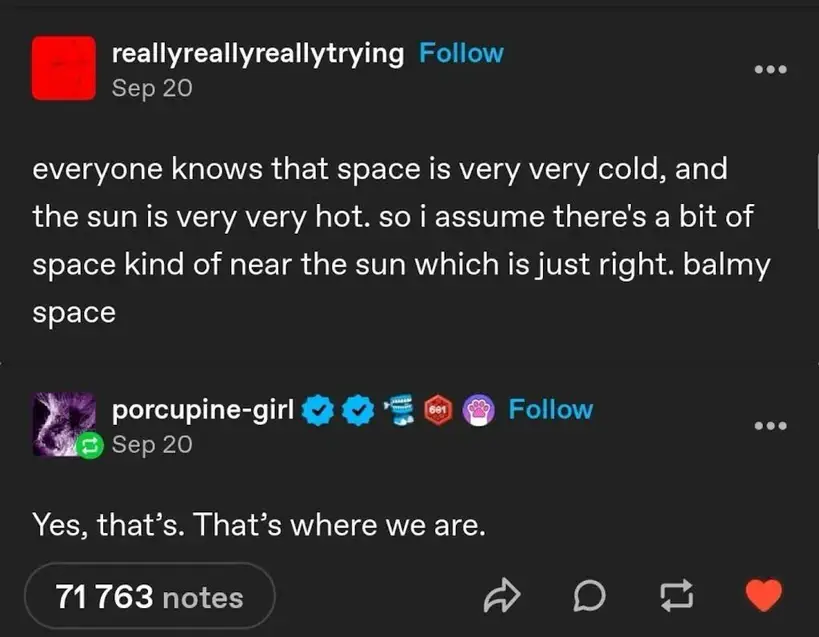
To expand on the “doesn’t work like that” part: In the vacuum of space there is no air to exchange warmth with your body, or your space suit. You might be comfy on the side of your body facing the sun (if you’re at that distance where it provides the right amount of radiative heat) but the side facing away from the sun will get no heat, and therefore be cold. I imagine that would feel very weird… if you could feel it on your skin, without a space suit, without being ripped apart by the vacuum, of course.
Does anyone know whether this “uneven distribution of heat energy” is a problem for space suits or if that little bit of air inside is enough to distribute it?
What if we spin around like a spit roast so the heat gets evenly distributed?
How fast should we spin as well?
I wonder what it would do in relation to vertigo. I mean there’s no gravity to affect the vestibular system, but there are strong visual cues.
Ah crap, I’m going to go down a “what happens when an astronaut spins” rabbit hole today, ain’t I? I had shit to do, oh well
There are glacier fed lakes when i live. You can float in incredibly cold water and if you have just the right equilibrium you can half float in freezing cold water while half getting a nice sun bath. And it IS very weird.
One spot I camped at for many years had nice sandy area that was about 200 meters out into the lake before a drop off. As it was only about a meter deep it used to warm up the top foot or so of the water when it was fairly still and you could stick your arm down into the water and actually feel the temperature drop like there was a line underneath the water.
Was great place to camp before it got overwhelmed by mosquitos
A lot of nice places in the world that are a joy to be in until the mosquitoes show up. Do we have to have mosquitoes? Can’t the world manage without them?
Oh wow, that sounds amazing! Apart from the mosquitos maybe.
If I can find some old pictures I’ll share
This uneven heat distribution confuses the brain and is perceived as pain. Veritasium (or maybe vsauce) did a video on it. Putting frozen and warm hotdog against the skin.
NASA EVA suits have liquid (water) cooling systems to avoid cooking the astronaut while outside the ISS.
I don’t know how they actually work though. The only way to shed the heat is to radiate it away or to sink it into warming something else up.
Found this on Wikipedia:
Though I think that’s specifically for removing the astronaut’s body heat.
What a great system. I wonder how the development of that worked. Did they theorize the necessity of a system like that or were the first space walkers quite unconfortable?
Why can some objects exist in space without getting ripped apart like a human would. Is that what actually happens to a human anyways?
Ever seen a picture of a blobfish in it’s deep ocean habitat vs when it is at the surface? It’s body is adapted to the extreme pressure of the deep sea, and when that pressure is no longer there, the forces keeping it’s shape are no longer present and thus every bit of it expands. That’s what would happen to us in the vacuum of space albeit on a lesser scale. Also, we’re like 70% water which boils in a vacuum.
As I understand it, this in fact will not happen. Our circulatory system is a closed loop and strong enough to not expand into vacuum. The water inside our body is kept close to usual pressure by our skin, blood vessels etc.
The main immediate danger in space without a spacesuit would be holding your breath. Your lungs are not built to withstand a whole atmosphere of pressure from the inside, and will get damaged if you hold your breath.
Of course if you don’t, you’ll have another problem.