- 14 Posts
- 25 Comments
Joined 3 months ago
Cake day: January 27th, 2026
You are not logged in. If you use a Fediverse account that is able to follow users, you can follow this user.


 2·17 hours ago
Yeah, it might be a good idea to check if the downspout isn’t partially clogged. I don’t know how high that building is, but around here, leaves can get in there every once in a while
If you haven’t checked yet, you might also want to see the abutment flashing (see #7 below) where that wall and roof meet, as water might be percolating in that area and getting trapped between the ceiling/drywall/insulation.

I’d also check the other flashings as well while you are at it and if that drywall and insulation on that affected area are damp, remove them for venting
I can’t tell too much from the pictures, nor feel and test the wood. You mentioned the plaster was soft, but what about the wood? Are there mycelium growth in it?
Check if the wood is dark, mushy, deformed, poke test it with a knife/awl/screwdriver, as wood with advanced decay will be soft and the probe will penetrate easily. How far does it go? How big is the beam? Do you know what kind of wood is it? Test in multiple areas
Tear up a more of the plaster to check how the rest of the beam looks like and test them. If it is less than 0.3 cm, venting might be enough
Another one is the pick test, where you insert the knife beneath the wood grain to pry loose a thin section of it till it breaks free. If you get a long linear splinter, itś most likely good, if it comes out as crumbly chunks or short pieces with a mushy sound, it is not ideal.
If you are in a dry season and no rain in sight, I’d clean both inside and outside areas to let them vent. Get a fan/dehumidifier/open windows in that room.
I also prefer breathable buildings, so you could use a more traditional breathable plaster, which allows water to easily evaporate over time, whereas concrete and all the PVA might help trap the moisture. It is typically made from lime and/or clay, sand, and water. You can also add fibers (horse hair or plant fibers) for strength
 3·1 day ago
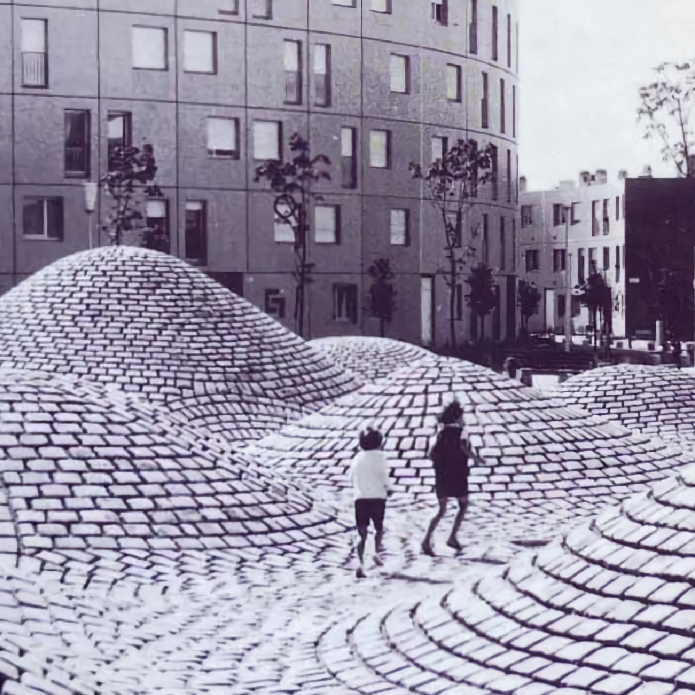
I’m probably biased in saying this, but I’m a fan of the red and green handbooks (handboeken Rood or Groen) from Amsterdam, but they are only available in Dutch, if you don’t mind using a translator to help you
It goes in depth and there are a lot of pictures and illustrations. It is based on the PDF alert! Puccini Method, which tries to make designs that are user friendly and accessible
You can find them here
A summary can also be seen here with the main principles
The two handbooks contain the technical specifications of the policy, including drawings, technical details and lists of materials.
PDF alert below!
- Red Handbook covers pavements, street lighting and street furniture.
- Groen Handboeken covers the correct planting of greenery in the city, including trees, perennials, grasses, shrubs and wadi gardens.
Are you sure all that humidity is coming from the outside? It looks like a really weird spot for that to happen
Why can’t you access the upper floor? Is this an apartment building and someone else lives above you? What’s in the black tube?
Perhaps you have already checked, but I’d try to rule out any infiltration coming from above, otherwise it will keep happening and it could get worse. If someone lives above you, they might actually be liable for these repairs depending on the laws of your country
 4·3 days ago
You might want to look into syntropic farming/food forests/agroforestry
Jim East (not to be confused with Jim West) usually posts some cool stuff on this topic and resources like this one: https://amazonrestore.codeberg.page/food-forests/
@wolfyvegan@slrpnk.net do you have any other recommendations?
I’m no specialist, but I’ll give my two cents. Anyone feel free to correct me if I’m wrong or a better approach is available
-
Yes, even galvanized steel will eventually rust when directly in contact with the ground and it was accelerated by the salty air from the coastal region. It also rusts faster in high humidity air/soil. Even after sealing the roof, it will rust again from capillary humidity from the soil if laid directly against it
-
Concrete or rock footing around 10-20cm above ground level is what I usually see, make sure the water drains and it isn’t pooling between footing and post. Those stirrups are usually galvanized steel, but if your post is already galvanized steel, I guess it wouldn’t make sense in your case
-
Based on the first image, if you were to use a concrete footing above ground, you might even be able to salvage this post, as the two screw holes look unrusted on the picture, and they seem to be around the level you’d need to cut. You might need to grind down the area and look on the inside to confirm it. If it is, you won’t even need new brackets
Otherwise, yes, a local shop will probably have some 90° brackets and bolts too. Keep in mind to accommodate the requirements for hurricane/flood/frost if your region is prone to it
-
how it handles the load exceeding capacity
As in what happens if you plug too much stuff that it exceeds your solar production?
I’ll use mine as an example, but it might be different with different models and configurations:
Inverter can handle up to 10kw
If solar production is at 5kw, and home is demanding 7kw, in my case, I have it set up as to draw the remaining 2kw from the battery, if battery is depleted, it will draw 2kw from the utility companyIf home demands more than 10kw that the inverter can handle, it will trip the internal inverter protection or a circuit breaker leading to it

We already have hybrid inverters that does that automatically, you don’t even need a different circuit or special outlets. It can manage all the grid ties, off grid and battery parameters on the fly
Subscribe! That would be quite interesting to follow along in future updates, if you don’t mind sharing
Unfortunately they usually do it on farmland around here, when they could easily go the agrivoltaics route. They would only need to raise it a meter or two and let the sheep roam around doing the trimming for them
Depending on location, it would have been cheaper to have those posts raised/reinforced in the first place instead of buying and hauling all that gravel
This one actually grinds my gears and it is too popular around here:

 17·14 days ago
They are already doing that, they even have a playbook on how to try to protect them, but apparently, “Physical protection is a set of structural measures that do not guarantee the safety of protected objects. Solutions do not exclude blast load and shrapnel impact.”
Solution What It Is Rosneft’s Own Admitted Weakness Cable barriers around tanks Cable/net mesh (40×40 cm) wrapped around storage tanks on pipe stands “NOT resistant to UAV shrapnel”; only protects against multirotor drones Scaffolding cages Modular metal scaffolding erected 5m above tank roofs “Insufficient volume of scaffolding to protect the Company’s facilities”; “high cost” Shipping container walls 20-36m high walls from stacked 20/40-ft containers with cable infill at 40 cm spacing Not yet pilot-tested; requires thousands of containers per refinery “Tent” canopy over tank farms Overhead cable-mesh tent using containers as structural supports (21m central mast) “Difficulties during firefighting”; “high snow loads” Tower crane mast cages Repurposed crane sections forming 4-pillar cage around processing units, cables at 1m spacing Each unit requires individual engineering; relies on surface foundations or guy-wires Three-barrier column protection Layer 1: cable screens 1-1.5m out from platforms; Layer 2: nets (40×40 mm mesh); Layer 3: kevlar/aramid wrapping In case of detonation, destruction is inevitable Cable fencing for pump stations 6mm cables at 500mm spacing on outrigger brackets Only designed to destroy drone airframe — does nothing against the warhead Reinforced concrete panels Reinforced Concrete wall panels replacing sheet-metal wind barriers at pump stations Only covers pump stations — the narrowest, lowest-value target category


 12·19 days ago
You can see both. Water heaters usually have a tank right behind or above them and it has a silvery tint to it. Blue hued ones are mostly electric panels
 1·19 days ago
Yes, plasma 6.6.3. I already had the “power management” setting “Dim Automatically” as “Never”, but it doesn’t seem to work on the second screen, as seen below:

 2·24 days ago
It really depends on your location and it could even include native grasses. I’d even recommend creating a post in the community asking for help so it gets more visibility
It is okay if you still need to have grass for children/high traffic areas, you don’t need to remove it all, as even small patches with native plants can make a big difference

 6·25 days ago
Do you also go to summer camp if you do not join the green team for season 2 of the button?
context: https://slrpnk.net/post/36144153
If you like videos, you should definitely watch Climate Townś “America’s Dumbest Crop” when you have the time:

 21·1 month ago
TIL it is mathematically impossible for all hungarian hospitals bathrooms to have toilet paper (according to Orban’s health secretary)


 2·2 months ago
As another user mentioned, it is an Arbutus Unedo in this case. It isn’t native to California, but some use them to attract pollinators as it flowers and fruits at the same time, specially at late season, as insects are preparing for winter


Sounds cool, come and share with us some of your !foraging@slrpnk.net