See crosspost(s) for more discussion:
This is the first big step in the process to develop comprehensive guidelines for the Fedecan non-profit and the various platforms.
While this will mostly involve converting tacit knowledge and experience into an explicit written form, we expect that this process will inevitably bring up some points of disagreement on the best way to deal with different issues. We ask everyone participating in these discussions to please contribute constructively and in good faith. We encourage you to bring up any concerns or issues you have with the proposed structure and drafted guidelines, so that we can work together to fix them early on. However, in order to keep a productive environment for those discussions, we will be pruning any comment chains that devolve into personal attacks, slap fights, etc.
To help ground your feedback, consider these thought experiments when evaluating a potential guideline:
- Veil of ignorance: Would it still feel fair to you if you switched places with someone else on the platform (ex. a new user, a moderator, an admin, a member of a vulnerable group, etc.)?
- Equal Applicability: These rules will be enforced uniformly on everyone. A poorly written rule that helps “your side” today, can easily harm “your side” in the future as circumstances change.
The full guidelines, including governance details like the annual review cycle, can be found on the website: https://fedecan.ca/en/guidelines/
We plan to structure the guidelines as follows:
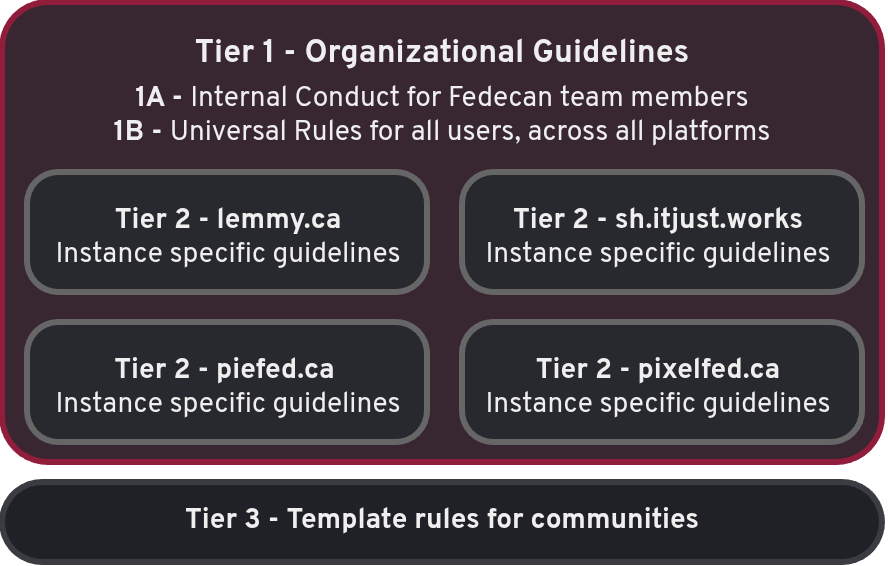
Tier 1: Fedecan Rules
Internal Conduct
These rules apply to Fedecan team members (directors, officers, admins, and anyone with elevated access). They set expectations for how team members should act.
Universal Rules
These are the baseline rules that apply to every user on every Fedecan platform. They cover the things that are prohibited by Canadian law (threats, hate speech, CSAM, non-consensual intimate imagery) as well as universal policy rules (privacy/doxxing, harassment, fraud, content that could cause harm, labelling of sensitive content, etc.).
Tier 2: Platform-Specific
Each platform has different functionality and norms, so this is where we can be more specific with the rules. The threadiverse platforms (lemmy.ca, piefed.ca, sh.itjust.works) share similar rules around community creation, moderation, vote manipulation, and content labelling. Pixelfed has its own rules tailored to its platform.
Tier 3: Community-Level Rule Templates
These are optional templates that communities can link to, or use as a starting point for their own rules. The idea is that moderators can point users to a clearly written explanation of why a rule exists, and any relevant exceptions, rather than trying to fit everything into the sidebar. Additionally, if many communities are enforcing a particular rule in the same way, then users will have an easier time understanding and following them.
The post title standards template has been drafted, and we plan to add more as the need arises. I have a few others that are in the works, but they have some overlap with the other sections, so I thought that it would be better to let people discuss first.
A few discussions:
- “Content that was created with the help of generative AI tools should be labelled.” What if you don’t know for sure, you’re reposting. Can I put “suspected AI?”
- Your Rule 6 in the universal rules is going to be hard to enforce. I like that it’s there, but the fediverse is so small right now, that we rely a lot on user reports. I’m not sure how to fix that. I don’t think some of the users here know they’re even being targeted, and then leave before it’s reported.
- Rule 9 is hard for us Americans. Our own government is doing that. Again, we’re small, so that one probably isn’t a huge issue yet.
Based on the Canadian charter? As a native American man, that doesnt fill me with a lot of confidence.
That is fair feedback. I was actually intentional with how I wrote that section:
We make up one part of the Fediverse, and we intend to have a positive influence on the rest of the network. Living in Canada, we’ve been shaped by frameworks such as the Canadian Charter of Rights and Freedoms, and its values naturally shape how we approach the decisions we make about our platforms.
My intent with that paragraph was to point out that our guidelines and enforcement may differ from how other jurisdictions handle similar content. The best way I thought to describe that was that as a Canadian team, those decisions will be guided by the social/cultural/legal frameworks that we are most familiar with, one of which is the Charter.
While doing the research for this, I came across the guidelines of some other platforms that explicitly tie their rules to the Charter. However, I didn’t want to do that. While the Charter does offer protections that other parts of the world don’t have, there is also plenty of academic discussion and criticism about the Charter and its limitations. It is a product of the political moment when it was created, and while it can shape some aspects of how a modern online platform should be run, there are going to be gaps that we need to address ourselves.
A related example is our Tier 1 Rule 2. We start with how the Criminal Code defines an “identifiable group”, but extend it to any group that a reasonable person would recognize as a target of hatred. The list on the Criminal Code goes back decades, and it takes a lot of time and political will to update it. An online platform meanwhile will need to address issues around hate quickly, and so we will need to use our best judgment on when we need to act.
I would love to clarify the wording around the Charter (and any other sections) to address the concerns, if you have a moment to share more thoughts on what to work on :)
I like what you’ve said, I guess I was just off put by the language. “Shaped by” the charter is very different than “inspired by” the charter. My worry is that if you tie yourself too strongly to an established legal framework, you bind yourself to the biases and loopholes of that legal system. You lose the flexibility and adaptability that I feel is more important in this particular format and forum. Say the charter is altered or expanded upon by conservatives in a way that discriminates against or targets lgbtq lemmys, tankies, or any other minority group. Would you be then forced to follow suit? Maybe rewrite your rules to exclude that portion of law? Thats a slippery slope all on its own. Section 35 of the charter only came about ~40 years ago. Its not a perfect document.
I would much rather read about policies and practices inspired by the intention and language of the Canadian charter than ones shaped by the realities of its current day application.
You mean the charter (section 35)where indigenous treaty rights are enshrined? See any of that in the US constitution?
Tell me where section 35 punished anyone for the atrocities committed against my people? Settlement is not punishment. When are the innocent children of white settlers scheduled to be taken from their homes and forced to learn indigenous customs and language? Whipped and beaten and raped for talking back? How about a fat cheque for me in compensation for the french last name i had my entire life?
Settlement is forgiveness, and Canada is not forgiven.
I think rule 5 should be amended to allow posting of PII for public figures with publicly available information however disallow any private information (like home address or personal cellhpone) of these public figures.
The current wording would mean you can get banned if you give out information on how to contact your MP (for posts about bad bills for example).
That’s good feedback, we can add a few lines to clarify that you’re allowed to share publicly available information. Maybe anything that is already shared publicly by the organization in question, such as information on the contact page of a company? I see some more feedback around rule 5 in the comments, so I’ll wait a bit before drafting up a new version.
I have made a note of your suggestion, thank you! Also happy cake day :)
Thank you for organising and sharing your rules and processes transparently. Scanning quickly, there’s lots here that must have taken a lot of work. The various hierarchies for users and rules seem sound. The rules themselves line up with what I’d expect and hope for as a user, particularly one based in Canada. I’ll check back to see some of the developing sections, like the AI guidelines, once theyre done. Thank you for including a changelog, and a commitment to annual review and updates, and what seems like a commitment to including community feedback.
Thank you :) I’ve been collecting notes from when users made suggestions, and that helped to get everything organized. It took a lot longer than I was expecting because there are so many resources out there to read and get ideas from.
I’ll check back to see some of the developing sections, like the AI guidelines, once theyre done.
Do you have any quick thoughts on what you want to see for that section, or any concerns that you want to see addressed?
Eh, I’d like to interact with as little AI as possible, recognising that that’s increasingly unlikely and realistically altogether impossible… but I’m from the before times so I’ll hold out hope. I imagine you’ll all be able to come up with reasonable, actionable guidelines that are more realistic than “No AI at all” and that you’ll sort through the challenges as they come up. Thanks again.
That sounds good, I’ve noted that down. Cheers :)
Please keep the rules in the sidebar so people on mobile devices can read them without leaving their client.
Definitely!
My plan was to have a short version of the rules in the sidebar of each site, with links to the relevant section of the full guidelines when people want to read more. That way the user can skim through the rules that don’t apply to them, and read more for the ones that they are curious about. We could also put the entire rules in the sidebar, but I think that might be overwhelming and result in users not reading them.
Honest input to your thoughts - as a registered/logged-in user, that Lemmy home page infobox is a UI/UX nightmare - it blocks my quick access to the second box below that has my subscribed communities. Upon visiting, I would immediately collapse that top box without ever looking at it; I now have a simple uBlock Origin rule that hides the top infobox on the home page for me automatically. On old.reddit, the list of subscribed things is a dropdown top left so they avoid this UI/UX problem with stacked infoboxes.
Yea that’s a good point. I know the Lemmy devs are working on a new frontend, and it would be nice to be able to customize some of these things.
Have you tried https://photon.lemmy.ca/ ? It is more customizable and it puts the subscriptions and sidebar on different sides
we have a few other frontends: https://fedecan.ca/en/guide/threadiverse/alternative-uis
(just talking shop) I’ve poked at them, you’d think the old.lemmy.ca would be appealing but not for me - I rather like this Lemmy webUI overall as a design. Good font sizes, line spacing and so forth - it has a well formed comfortable feel which I can tell has an experienced eye to it (minor details matter). Conversely, when I look at, say piefed or old.lemmy I just got “ugh, those fonts! that line spacing!”. The default UI is actually a well crafted piece of usability kit - the infobox is an Achilles heel.
Random: I’ve used the Lemmy webUI details to craft similar feeling looks to HackerNews and (old) Reddit using nothing more than uBlock filters. Nothing grandiose but the fine tuning makes them sorta feel like the Lemmy UI (but worse, holy cow is there so much hard coded HTML in these old sites - lipstick on a pig but it helps).
Looking forward to diving into this.
Please do :)