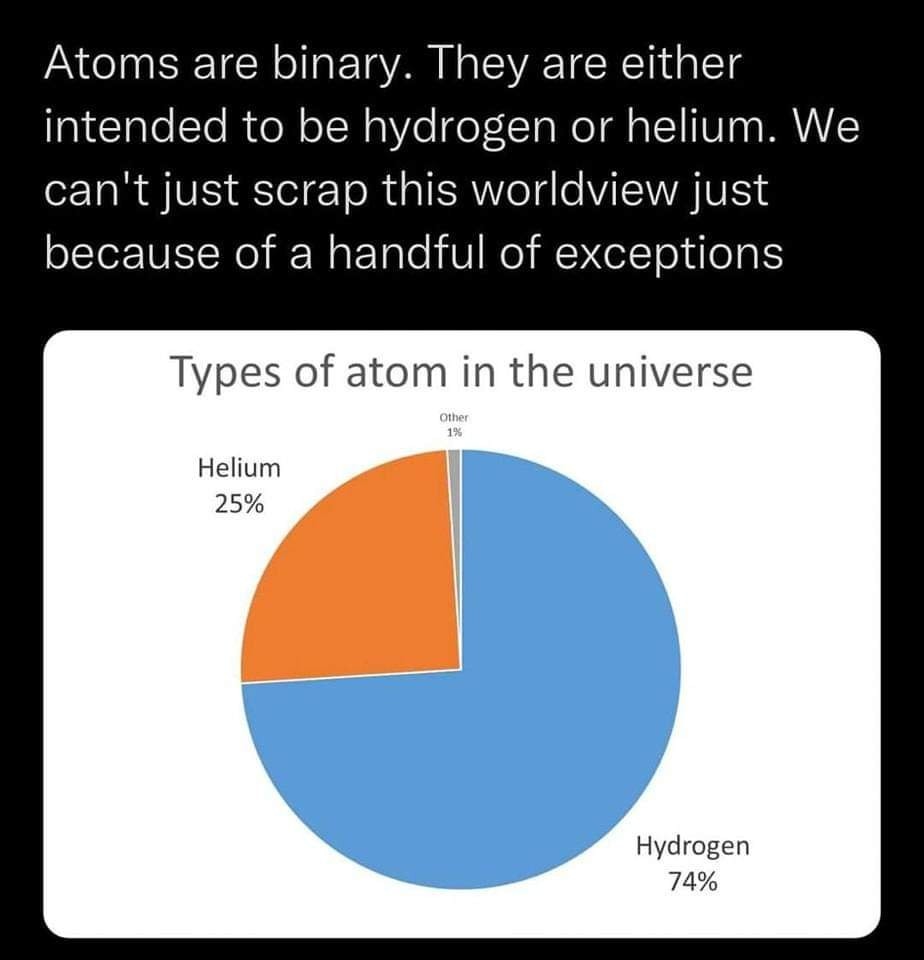

I get what you are saying but this is actually how science works. If you want to higher level of abstraction you do generalize, if you want to go to detail you want as much categories as possible to differentiate noise from actuall difference.
If you want to calculate the mass of the milkyway it might be reasonable to focus only on these two element, however if you want to study the mass of the planets of our tiny solar system you can probably consider other elements too.
So there are good cases when to differentiate and when not to. Which is probably not the point you wanted to make.
Just like genders, I get it
This entire pie chart makes up the less than 5% of the actual Universe made up of particles that our crude senses and instruments can detect.
We are a bit of cosmic pollution; the Universe would be essentially unchanged if all normal matter in it disappeared.
And some people think Sky Daddy made the whole thing Just For Them
While dark matter does appear to be a real physical thing we just can’t detect very well (since we can roughly detect where it is and isn’t, and it sometimes shows up where ordinary matter is absent, or is absent where ordinary matter is), I’m not totally convinced that dark energy is actually physical energy – the same effects could potentially be explained by some as-yet undiscovered property of spacetime itself, without any unseen ‘energy’ causing it to do that.
While I agree, this line of argument could be taken to bolster Sky Daddy’s love for us and only us.
The whole universe is so different from us, but our little bitty part is just right. Clearly, Sky Daddy made the particles our crude sense and instruments can detect just for us, but Sky Daddy truly is unknowable (and made of the other stuff).
What are the chances that we would evolve on a planet with the perfect atmosphere and biome for us to survive? Checkmate, atheists.
What is the chance anteaters would evolve on a planet with the perfect atmosphere and biome for them to survive? Do you think the perfect food just randomly evolved by happenstance? Obviously this universe was created for anteaters.
That just proves that God is an anteater
@PugJesus reminds me of the physics proof that all odd numbers are prime
1 is odd and prime
3, ditto
5, ditto
7, ditto
9, experimental error
11, ditto
.
.
.If you wrote an algorithm that just outputs yes for all youd be 94% correct
AI is about 60-90% correct for comparison
The funniest part about this is 1 isn’t even prime.
That’s always irked me. I get that one is very very special.
It’s probably because I learned that a prime only “has factors of one and itself”… rather than “exactly two unique factors” per se.
It’s more that all the interesting things that come from prime numbers don’t really work if you include 1 as a prime. So every time you talked about primes you would have to say “something something prime number, other than 1, yadda yadda”.
For example: The Fundamental Theorem of Arithmetic states that every natural number can be expressed as a finite product of primes, and that prime factorization is unique.
So
12 = 2^2 x 3is the only way to express 12 as a product of primes. But if we include 1 as a prime, then
12 = 1 x 2^2 x 3
    = 1^2 x 2^2 x 3
    = 1^3 x 2^2 x 3
etc. There are infinite prime factorization of every natural number, and the most interesting part of the Fundamental Theorem of Arithmetic no longer holds.
That… helped! :-)
TYVM for explaining that!
I also always loved Xeno’s paradox … specifically the Dichotomy Paradox (Halving): To travel from point A to point B, you must first reach the halfway point, but before you reach that halfway point, you reach the halfway point of those two points and on and on and on into infinity … which suggests that in order to get from any point A to any point B, you have to cross infinity … but it’s impossible to travel to infinity so the suggestion of the paradox is that you should never be able to reach any point B
I don’t think I get it, the conclusion doesn’t make any sense to me at all
Because yes, there is an infinite amount of infinities when you think of decimals. We have two when it comes to integers - negative infinity and positive infinity, and there is an infinite amount of infinities between any two integers. 0 - 1, but also between 0.1-0.2, etc
That doesn’t mean you can’t add or multiply any two numbers just because there is an infinity inbetween.
That’s the paradox and that’s why I love this thought experiment.
There is infinity in everything and everywhere … yet we are told that we can’t cross infinity … yet we do it all the time.
We cross infinity all the time. Git gud

… to infinity … and beyond
and you don’t fly there either … you’re just falling with style
I’m not sweatie, you’re sweaty
Sweat is disgusting oxygenist propaganda. Why can’t you just leak pure hydrogen from your pores like a normal molecule?
I don’t eat the sweats, I just lick them for the salt content