

Google moves to lock down the Android operating system, effectively stealing features away from millions of existing users.
That’s why my phone looks like this and will look like this for years

Not to defend Google, but they have said they will leave a way for people to sideload. Still sucks that they feel justified in making it more annoying https://www.androidauthority.com/google-android-17-sideloading-interview-sameer-samat-3647478/
I really want a pixel so I can install GraphineOS
I don’t want to be a party pooper but I can’t help feeling that buying Google’s hardware to avoid Google’s software might not pan out in the long run.
I know. Ironic, isn’t it? But as far as I am aware, only Google Pixels support GraphineOS.
Until this alleged Motorola collaboration bears fruit, Pixels are all there is for GOS.
Next Motorola will not even fund google
I’ve moved from Android to CyanogenMod, then Lineage OS, and now Graphene OS. I have zero interest in a proprietary, locked down platform.
If they really want me to use a Linux tablet, I will.
Holy hell it’s been a while since I heard that name… I remember putting Cyanogen on my PSP back in the day.
Neither lineage nor graphene are an option. Google still control the platform.
We need a law that forces Google to open the platform for competition. I hope for EU to come swinging and slapping Google silly very soon.
Or hope for Chinese to come up with Linux hardware we can just use.
The sad part is that LineageOS, GrapheneOS and basically all Android alternative OS are built on top of the AOSP, which Google controls, and they’re staling updates to twice a year. These stalled updates may include critical security patches or device compatibility support.
Furthermore many android devices prevent users from entering a boot state which lets the owner install the OS of their choice, making everything more complicated.
Absolutely, Google can kill off Android by making it a walled garden, like iOS, but worse. We’ll see what the Motorola GOS device will be like.
I can definitely go back to tethered Linux WiFi tablet. Maybe something chinese, based on RISCV.
I’d love to put Lineage or Graphene on my phone, but neither one supports it. I think these OS fall prey to the “losing the hardware lottery” problem that Linux has, a term coined by @mcc@mastodon.social. So imagine a world where we do get Linux on a phone, how easy it would be to lose that lottery.
I have never lost the hardware lottery, by virtue of not playing it. I buy my hardware to support the OS I run, not the other way round.
A little holier than thou don’t you think? Like I’ve got existing hardware and I’m leaving Windows. If (for example) Bazzite doesn’t work on my hardware, you think I should go out and buy brand new hardware to run Bazzite? Or maybe find some way to extend the lifetime of the hardware I have?
I mean you even admit yourself that you moved from one Android OS to another. You bought a new phone every time you went from Cyano to Lineage to Graphene?
I’m assuming people are buying a new system. If you have legacy hardware, that’s a crapshoot. If you’re a gamer and are moving to Linux that can become difficult, due to your special requirements. Good luck with your migration.
I am buying new hardware when the old one breaks or becomes unusable. My LOS Poco X3 Pro from end 2021 has a bad case of ghost touch, so I bought a new Pixel 7a end 2024 for GOS. My LOS Galaxy Tab S5e from mid-2022 refurbished is somehat usable, but my main driver since mid-2025 is a Pixel tablet with GOS.
These are reasonably long lifecycles, and I try to buy refurbished when possible.
Hard fork.
ABI app layer a la wine/proton.
Its time.Doesn’t help really, since very few phone OEMs have unlocked bootloaders to even enable running custom roms.
As developers keep trying harder to appeal to Google’s kindness and not kill off privacy-based usage of it’s OS, we just keep falling further behind in creating a real-world usable linux phone that can do everything a phone is supposed to do.
Instead of writing a strongly worded letter to Google, EFF should have used this chance to let the community know that the boat is sinking and it’s long past time to jump ship.
Jump where? The alternatives currently require a small selection of hardware; are expensive; don’t offer the same level of service; or all the above.
That was literally my point. The reason there’s no linux phone is because everyone keeps trying to work within Google’s ever-shittier restrictions instead of having made real progress on a linux phone alternative. Now everyone is staring down the barrel of a scenario where they lose their non-Google android phone and still the entities that are supposedly working for our privacy are writing letters to Google asking them to please not be such a corporate giant intent on serving ads and knowing the location of 100% of their OS users.
The linux phone landscape is so terrible because developers keep wasting their time trying to work with Google instead of offering an alternative that works.
Yeah, probably jump ship to a life without a mobile phone, online banking and train tickets. 🙁
I don’t intend to get rid of my smartphone, but I do carry a larger device with me, and try to use the phone increasingly as just a dumbphone and cell modem for that device to tether to.
That may not be viable for everyone — it’s not a great solution to “I’m standing in line and want to use a small device one-handed”. And iOS/Android smartphones are heavily optimized to use very little power, and any other devices mean more power. It probably means carrying a larger case/bag/backpack of some sort with you. And most phone software is designed to know about and be aware of cell network constraints, like acting differently based on whether you’re connected to a cell network for data or a WiFi network for data.
However, it doesn’t require shifting to a new phone ecosystem. It also makes any such future transition easier — if I have a lot of experience tied up in Android/iOS smartphone software, then there’s a fair bit of lock-in, since shifting to another platform means throwing out a lot of experience in that phone software. If my phone is just a dumbphone and a cell modem, then it’s pretty easy to switch.
And it’s got some other pleasant perks. Phone OSes tend to be relatively-limited environments. They’re fine for content consumption, like watching YouTube or something, but they’re considerably less-capable in a wide range of software areas than desktop OSes. A smartphone has limited cooling; laptops are significantly more-able to deal with heat. Due to very limited physical space, smartphones usually have very few external connectors — you probably get only a single USB-C connector, and no on-phone headphones jack. You’re probably looking at a USB hub or adapters and rigging up pass-through power if you want anything else. Laptops normally have a variety of USB connectors, a headphones jack, maybe a wired Ethernet connector, maybe an external display jack. Laptops tend to have a larger battery, so it’s reasonable to use the laptop to power external devices like trackballs/larger trackpads, keyboards, etc. You get a larger display, so you don’t have to deal with the workarounds that smartphones have to do to make their small screens as usable as possible. You don’t have to deal with the space constraints that make a touchscreen necessary, having your fingers in front of whatever you’re looking at (though you can get larger devices that do have touchscreens, if you want). You have far more choices on hardware, and that hardware is more-customizable (in part because the hardware likely isn’t an SoC, though you can get an SoC-based laptop if you want). Software support isn’t a smartphone-style “N years, tied to the phone hardware vendor, at which point you either use insecure software or throw the phone out and buy a new one”.
Yes. My question is just, how do you participate in modern life with that? For example if you commute by train, you need a ticket. And the Deutsche Bahn tries to get rid of paper tickets. Their monthly subscription is an App now, available for Android and Apple. Do you install Waydroid and whip out your laptop once the conductor asks for your ticket? Do you also pull it out of your backpack 3 times on the platform to look up all the delays, changed platforms, trains you have to transfer to? What’s with the pkpass file for the concert, cinema, exhibition? I mean we can still print the QR codes. I do that, I have a printer at home and sometimes do the extra effort. I can’t take my laptops and tablets to concerts. And some other things will get more complicated as well. For example Shop & Go is almost impossible without a phone. You’re guaranteed to wait in line at the few cash registers left and waste an extra 10min… You’ll have to apply for a chip card to charge your EV, can’t update some of your electronic gadgets any more… And if you drive by car, how do you listen to Music and Podcasts? With an USB stick or a 12xCD changer in the trunk like in the early 2000s?
MVV app is super convenient, but I could still use the kiosks without too much added delay. MVVswipe is like 30 seconds to “check out” a ticket, MVV kiosk machine is like 90 seconds. The biggest inconvenience is having to find a kiosk outside of a train station.
I don’t presently need to use any service that requires use of a smartphone. I’ve never had a smartphone tied to a Google/Apple account. I don’t even think that I currently have any apps from the Google Store on my phone — just open-source F-Droid stuff.
It’s true that hypothetically, you could depend on a service that does require you to use an Android or iOS app to make use of it. There are services that do require that there. Lyft, for example, looks like it requires use of an app, though Uber doesn’t appear to do so. And I can’t speak as to your specific situation, but at least where I am, in the US, I’ve never needed to use an Android or iOS app to make use of some class of service.
But I will say that services will track what people use, and if people are continuing to use other interfaces than smartphone apps to make use of their services, that makes it more likely that that’s what they’ll provide.
I can’t promise that somewhere in the world, or in some country or city or specific place, someone might be required to use an Android or iOS app, or if not now, down the line, and not have an alternative. They can, at least, limit their use to that app, rather than using it more-broadly. I don’t make zero use of my smartphone software now — like, when I’m driving, I’ll use the open-source OSMAnd to navigate. I sometimes check for Lemmy updates when waiting in line or similar. I don’t normally listen to music while just walking around, but if I did, I’d use a music player on the phone rather than a laptop for it. But I try to shift my usage to the laptop as much as is practical.
Welcome to Linux on desktop a few decades ago!
Not for the expensive part though
falling further behind in creating a real-world usable [libre] phone that can do everything a phone is supposed to do.
Tis a cost analysis:
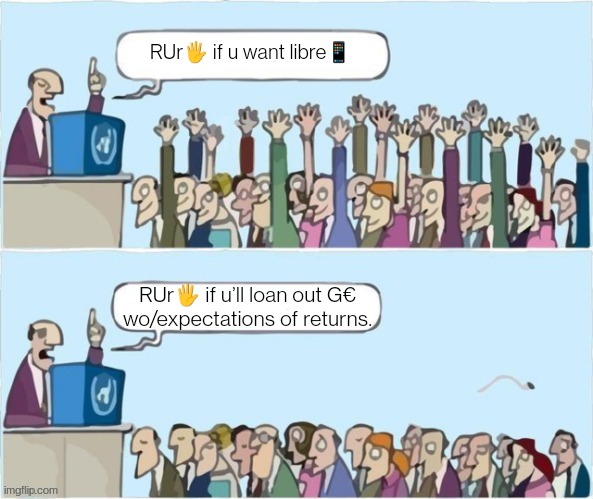
Our planet is too illiterate to loan out billions of euros to R&D a phone design with the hellish logistics of sourcing parts, assembly & shipments, even if we gift the phone schematics on a radicle instance. I say this as someone experienced on lots of failed investments. Even as I await this plausibility. There are others like these.
EFF should have
Designed and spearheaded their own. Detailing risks, dangers, and threat models.
Is that seriously Janeway on the PADD on the nightstand?